
How to Encourage Active Risk Assessment With Forklift Operations
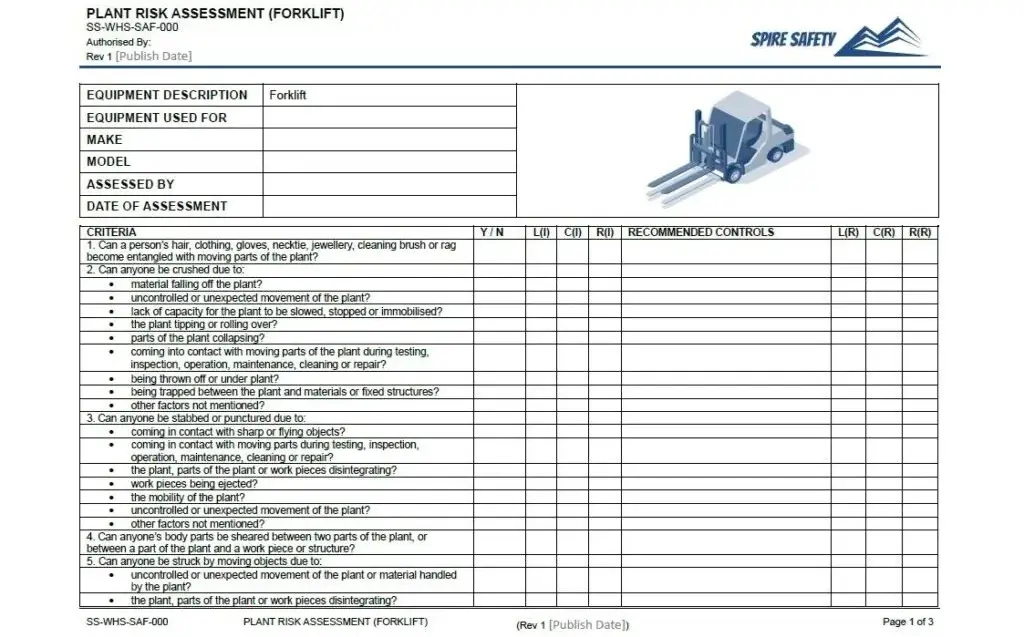
Forklifts are among the most useful, and most dangerous, pieces of equipment found in Australian workplaces. Used daily in warehouses, distribution centres, manufacturing facilities, and shipping yards to lift, stack, and transfer loads, they are a fundamental part of how goods move through the supply chain.
They are also one of the leading causes of serious workplace injuries and fatalities across Australia.
What makes forklifts particularly hazardous is that the risk does not fall solely on the operator. Pedestrians, co-workers, contractors, and visitors can all be seriously injured or killed in forklift-related incidents — often through no fault of their own. And because forklifts are heavy, fast-moving, and carry significant loads, even a low-speed incident can have devastating consequences.
The encouraging reality is that the vast majority of forklift incidents are preventable. They happen not because forklifts are inherently uncontrollable, but because hazards were not identified, risks were not assessed, and controls were not put in place.
This guide will show you how to build a culture of active risk assessment in your workplace — and keep everyone who works near a forklift safe.
Why Active Risk Assessment Matters
Risk assessment is not a box-ticking exercise. Done properly, it is one of the most powerful tools a business has for preventing injuries, reducing downtime, avoiding legal liability, and protecting its people.
A structured risk assessment process helps your business to:
- Identify and take control of workplace hazards before incidents occur
- Create genuine safety awareness among your entire workforce
- Meet your legal obligations under Australian work health and safety legislation
- Minimise the frequency and severity of workplace incidents
- Reduce the financial and human cost of injuries, equipment damage, and lost productivity
Most importantly, a risk assessment opens up conversations. It brings supervisors, operators, and workers together around the same question: what could go wrong here, and what are we going to do about it? That conversation, repeated regularly and taken seriously, is what builds a genuinely safe workplace.
Responsibilities — Who Is Accountable?
Before anything else, it is essential to be clear about where legal and moral responsibility sits.
As a business owner, site manager, or supervisor, you have a duty of care to everyone who enters your workplace. Under Australian work health and safety law, that means you are responsible for:
- Providing a safe physical work environment
- Establishing safe systems of work
- Supplying well-maintained, roadworthy machinery and equipment
- Ensuring all employees receive adequate training, information, and supervision
- Keeping your safety practices and documentation current
In practice, for forklift operations this means having the right controls in place — enforced speed limits, clearly marked pedestrian zones, reversing alarms, operational horns, correctly fitted and worn seatbelts, warning signage, and defined traffic routes.
If you are not certain whether these controls are in place and working effectively at your site, a risk assessment will tell you. That is exactly what it is designed to do.
Step 1 — Identifying Hazards
The first step in any risk assessment is to identify the hazards present in your workplace — the conditions, situations, or activities that have the potential to cause harm.
Inspect your workplace in person. Walk the site with fresh eyes. Look for areas where forklifts and pedestrians share space, blind corners, narrow aisles, poor lighting, uneven surfaces, congested loading docks, and anywhere that visibility is compromised. Think about what could go wrong in each location, not just what has gone wrong in the past.
Talk to your operators and employees. The people who work on the floor every day have an intimate understanding of where the pressure points are. They know which corners are tight, which intersections are blind, and which tasks feel unsafe. Employees should already be reporting hazards as they arise, but a structured conversation during a risk assessment surfaces issues that might otherwise be overlooked. Involving your team also builds ownership — when people contribute to identifying risks, they are far more invested in controlling them.
Think beyond immediate incidents. Not all hazards cause immediate, visible harm. Consider the long-term effects of working conditions as well. Sustained exposure to high noise levels, for example, can cause permanent hearing loss over time. Repeated physical strain from poor ergonomics or rough surfaces can lead to chronic musculoskeletal injuries. These cumulative hazards deserve the same attention as acute risks.
Step 2 — Identifying Who Is at Risk and How
Once you have identified the hazards, the next step is to determine who could be harmed by each one, and in what way. Different people face different risks, and understanding this shapes the controls you will need to put in place.
Forklift Instability and Tip-Over Risk
The single greatest danger associated with a forklift is the risk of it tipping over. A forklift that rolls has the potential to kill or seriously injure the operator and anyone nearby, and to cause significant equipment and property damage.
Operators must wear seatbelts at all times. A seatbelt keeps the driver inside the protective overhead guard in a tip-over — stepping out of or being thrown from a rolling forklift dramatically increases the likelihood of fatal injury.
A forklift can become unstable and tip over when the operator:
- Reverses too quickly
- Brakes too sharply or suddenly
- Accelerates or brakes while turning a corner
- Accelerates or brakes on a slope
- Collides with another vehicle, structure, or object
- Carries an unevenly balanced or improperly secured load
- Travels with the forks raised too high, with or without a load
Each of these behaviours shifts the forklift’s centre of gravity outside its stability triangle — the invisible boundary within which a forklift remains upright. Training operators to understand and respect this concept is fundamental to safe operation.
Operator Sprains, Strains, and Musculoskeletal Injury
Forklift operation involves repetitive physical demands that, over time, can cause serious and lasting health problems. Common musculoskeletal hazards for operators include:
- Driving repeatedly over bumps or uneven floor surfaces, transmitting vibration through the body
- Repeatedly craning the neck upward when stacking loads at height
- Repeatedly turning to look behind while reversing for extended periods
These may seem minor in isolation, but cumulative exposure leads to chronic neck, back, shoulder, and arm injuries that can affect an operator’s quality of life long after they leave the workplace.
Pedestrians and Third Parties
Pedestrians in forklift operating areas are at significant risk — often more so than the operator, because they may not see or hear the forklift approaching. Particular attention should be paid to groups who may have different risk profiles or awareness levels, including:
- Young or new workers who may be unfamiliar with forklift hazards
- Workers with disabilities that affect mobility, hearing, or vision
- Migrant workers who may face language or communication barriers
- Infrequent site visitors — contractors, delivery drivers, auditors, and cleaners — who may not know the site’s traffic rules or danger zones
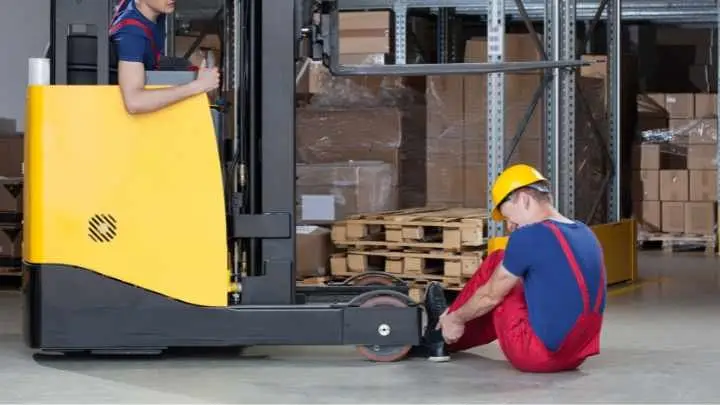
Step 3 — Evaluating the Risk
Identifying a hazard is only the beginning. The next step is to evaluate each risk — to understand how likely it is to cause harm, how severe that harm could be, and therefore how urgently it needs to be addressed.
For each hazard, consider:
- How severe could the injury or damage be in a worst-case scenario?
- How many people are exposed to this hazard, and how often?
- Is this a constant risk or something that arises only occasionally?
- What controls are currently in place, and are they working?
Compare your current practices against recognised industry standards and Safe Work Australia guidance for forklift operations. This comparison will quickly reveal the gaps — the areas where your current controls are inadequate or absent — and help you prioritise where to act first.
Step 4 — Recording Your Risk Assessment
A risk assessment that exists only in someone’s head provides no legal protection and no operational value. Every assessment must be documented.
Your written record should capture:
- The hazards identified and where they exist in the workplace
- Who is at risk and how they could be harmed
- The current controls in place and their effectiveness
- The additional actions required and who is responsible for implementing them
- Target completion dates for each action
This document becomes a working reference — something you return to, update, and improve over time. It also provides critical evidence of due diligence if an incident ever occurs and your safety practices are scrutinised.
Alongside the assessment, develop a clear action plan that sequences your risk control measures in order of priority. Address the highest-severity, highest-likelihood risks first, and work systematically through the remainder.
Developing a Forklift Traffic Management Plan
One of the most effective structural controls you can implement is a formal Traffic Management Plan (TMP). The goal of a TMP is straightforward: to physically and operationally separate forklifts from pedestrians wherever possible, reducing the opportunity for a collision to occur.
A Traffic Management Plan should be developed in consultation with your employees, following the same risk assessment process outlined above.
Identify the Hazard
Study your workplace layout carefully. Map out all forklift routes, pedestrian pathways, loading and unloading zones, storage areas, and intersections. Identify every point where forklifts and people currently share space or cross paths. Review your historical incident and near-miss reports — these are invaluable for understanding where your real risk hotspots are.
Ask your operators directly: where do they feel most at risk? Where have they had close calls?
Evaluate the Risk
For each identified collision risk point, assess:
- The severity of injury that could result from a collision at that location
- How frequently pedestrians and forklifts interact at that point
- Whether the risk is constant or arises only during specific operations or shift periods
- Whether the current layout gives operators and pedestrians adequate time and space to see each other and react
Control the Risk
The hierarchy of controls applies here as it does everywhere in safety management. Elimination is the most effective control — if you can redesign the workplace so that forklifts and pedestrians never share space, you have removed the risk entirely. Where elimination is not practicable, work down through the hierarchy:
- Elimination — Remove forklifts from areas where pedestrian interaction is unavoidable, or relocate pedestrian pathways entirely
- Engineering controls — Install physical barriers, guardrails, or overhead pedestrian walkways to separate traffic; implement intersection mirrors at blind corners; install speed-limiting devices on forklifts
- Administrative controls — Establish clear, enforced forklift-only and pedestrian-only zones; implement strict speed limits; create defined crossing points with give-way rules; introduce a permit system for pedestrians entering forklift zones
- Signage and visual aids — Install clear, prominent warning signs, painted floor markings, and flashing warning lights at key interaction points
- Training — Ensure all operators hold current, valid forklift licences and receive site-specific induction; ensure all employees understand the site’s traffic management rules and their own responsibilities
Review Your Control Measures Regularly
A Traffic Management Plan is not a document you create once and file away. It must be reviewed and updated regularly, and specifically whenever:
- A near-miss or incident occurs on site
- Changes are made to the workplace layout, workflow, or equipment
- New employees join the team
- Forklift routes or pedestrian pathways are modified
Reviewing your controls confirms that the measures you have implemented are working as intended, and ensures that new hazards introduced by changes to the workplace are promptly identified and managed.
Building a Culture of Active Risk Assessment
The most well-documented risk assessment in the world will not keep your people safe if safety culture is poor. Genuine workplace safety comes from an environment where every person — from the site manager to the newest employee — feels responsible for identifying and reporting hazards, and confident that those hazards will be taken seriously and acted upon.
Here is how to build that culture:
Make risk assessment a regular habit, not a one-off event. Schedule formal reviews at least annually, and conduct informal walk-throughs regularly. Safety awareness should be a standing agenda item in team meetings.
Encourage reporting without blame. If your employees fear consequences for raising safety concerns or reporting near-misses, hazards will go underground. Create an environment where reporting is actively encouraged and genuinely appreciated.
Close the loop. When an employee raises a hazard, let them know what action was taken. Nothing kills safety culture faster than concerns disappearing into a void.
Lead from the front. Safety behaviour starts at the top. If managers and supervisors follow the rules — wearing PPE, observing speed limits, taking hazard reports seriously — operators will too.
Invest in training. Ensure all forklift operators hold current licences and receive regular refresher training. Ensure all site workers understand basic forklift awareness, traffic rules, and what to do in an emergency.
Our Final Word
Forklift incidents are not inevitable. They are the product of unmanaged risk — hazards that were not identified, assessed, or controlled. With a structured approach to risk assessment, a well-designed Traffic Management Plan, and a genuine commitment to safety culture, Australian businesses can dramatically reduce the likelihood of forklift-related injuries and fatalities.
Don’t wait for an incident to prompt action. The time to assess, plan, and act is now.